In 1973, three years after the first edition of Design for the Real World was published, Victor Papanek was on sabbatical at the Danish Royal Academy of Art and Design. That year, in a letter to William Lund, the President of California Institute of the Arts, he wrote: “Maybe because I have written Design for the Real World (which is now in 9 languages) I find myself increasingly bombarded by letters from students in many parts of the US and the rest of the world who would specifically like to study with me. […] I have 9 such students here from Germany, Mexico, Indonesia, Canada, USA, India, Kenya and Great Britain.” One of those students was the 33-year- old Pak Imam Buchori, an Indonesian arts graduate on a year-long exchange programme in Copenhagen. In December 2017, while living in Bandung, Indonesia I had that pleasure of interviewing Pak Buchori. In that interview he reflected on his experiences as a student under Papanek, and described some of the ways Papanek influenced him as an academic, teacher, and designer in Indonesia.
What did you teach my students?
In 1972, the Industrial Design programme at the Institute Technology Bandung, Indonesia, opened its doors for their first cohort of students. The year before, its 33-year-old founder, Pak Imam Buchori, set off for a yearlong exchange programme at the Danish Royal Academy of Art and Design. His time in Copenhagen was spent under the mentorship of Victor Papanek. “it was just coincidence you know that I was attached to Victor Papanek … I was introduced by Erik Herlow, the Dean of Industrial Design … and Papanek seem(ed) to like me because I was from the other side of the world.” At that time Victor was on sabbatical in Europe. In letters to his colleagues back at CalArts, Papanek frequently mentioned the promise of his international students and the importance of developing programmes to support them. In a letter to William Lund he wrote “Maybe because I have written Design for the Real World (which is now in 9 languages) I find myself increasingly bombarded by letters from students in many parts of the US and the rest of the world who would specifically like to study with me…” He suggests there is an opportunity to “provide supervision and guidance to real-life design projects by a small (and carefully screened) group of graduate students from various parts of the US and abroad… This can work, I have 9 such students here from Germany, Mexico, Indonesia, Canada, USA, India, Kenya and Great Britain…” (1) Pak Buchori was one of those students and he“worked with Victor Papanek with FULL dedication.” “Victor Papanek was a very radical one you see, like the opposite of Bauhaus”. “When I talk to Erik Herlow – the three of us yeah? Erik Herlow, Victor Papanek, and me myself – … I still remember in my ear “What did you teach to my students?!”
“Papanek gave some, …, not instructions, but clues for developing countries, “you have your own problems not the western one.”” At that time, Indonesia was pursuing its first 5-year plan under the ‘New Order’ government of President Suharto. “There was hope in the very beginning, because we have long development plan, and long development plan especially in Industry.” After years of neglect under President Sukarno, economic development and ‘modernisation’ was now a government priority which opened up an opportunity for industrial design. “In my opinion, when we talk about design, industrial design (is)… not deep into the economic foundations of Indonesia, because …until just about … 15 years ago, there was nothing called the real industry in Indonesia… They of course built a core industry, but what they mean by the industry is if you produce a product which is similar, but what I mean by industry is innovation… This is nothing at all the background of Indonesia industry. Mostly industry was extensions of the old industries owned by the Dutch people… and it just continued like that. There’s no real thinking about the industrial. …”
In 1971, Papanek had published the first edition of Design for the Real World which proposed an alternative philosophy of design which focused on solving ‘real-world’ problems rather than a design which contributes to a growing consumer culture. “In a Western thinking there’s three roles; … production, distribution and consumption. … But you know in Indonesia… production is more or less like distribution, its actually commerce, no production …, and as a consequence there is no consumption …, because consumption in western thinking is to produce or to make…new consumers to cope with … ever increasing productivity. So, you have to create consumer(s), and we don’t have that such philosophy (in Indonesia).”
“So, anyway, I went to the class of Victor Papanek for two full semesters, and by the time I made … I think perhaps four projects.””(It was) my obsession to work for Indonesian’s real problems”, “so I took the object of study of the way Indonesian cook with kerosene stove, and then I want to make it modern of course, to make it efficient, because I know the way the kerosene design was very clumsy and they (are) just dirty, and you know there is a lot of problems with filling and refilling the kerosene glass…so, this was the first project, and I did it all the way myself … it was quite pretty by the way… I made it, but what happened, (with) this one, because I didn’t have much knowledge of hydrodynamics or engineering or such … when I tried to burn it, WHAH! The whole place was FLAMING! Ah, I was so nervous, you know, and there were students in the room, and all burned down you see!”
“The second project, this is also done by myself, this is a lampshade… it’s a modern one, and …, actually, perhaps the form was influenced by Bauhausian… well of course you can light it up and light it down and do whatever you want, but the idea is you know … in Indonesia you meet a lot of insects, and they go in and are trapped here and the insect fall down in this place… It is quite clever design by the way, … it’s very a very precise one. … And this one, Papanek admired very much … He took a photograph. But what he emphasised is not the beauty of the design itself – it was very pretty, which I liked very much – but he liked the function of this, the insects trapped inside this one you see… But of course, he knows the design is a pretty one because this one can be slotted down and then up or something like that. It is a very nice one… It took a LONG TIME you know, because I have to make mould of this plastic injection myself, and to lathe it out of wood and then later make a join of this you see – it is really mechanic job.”
“The third project was … a design… to avoid children taking pills. That design is a problem solving one – so different students solved with (a) different approach. The way I approached (it) was using the difference between children weight to adult one you see. … you push it here (with) your weight, then it will shrink like this to unlock the door… I think the problem given by Papanek is, quite, you know challenging, because different students have different approach. I still remember…, one of the Danish student’s… design with the difference of three fingers all together put in a hole… which cannot be reached by a little boy… so the differences he manipulated were different (to mine).”
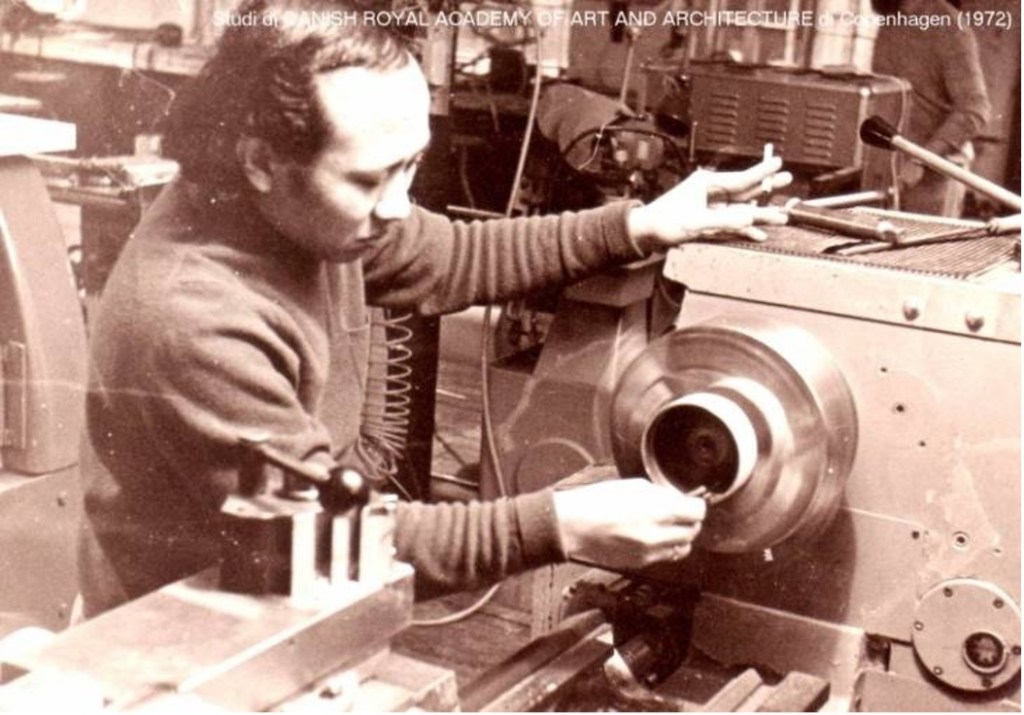
“The fourth project… is a candle holder… actually this is not too important project… But you can imagine, four projects in two semesters. If I gave to the students here one semester they just made a model not real one but this one (is) the real one – every prototype I design you see. And that’s what I like about Papanek (!), because a lot of student’s work in Denmark, they usually …(produced)… not the prototype, but a model, and models sometimes they don’t work, it’s just a model and the same shape…, but this one is completely workable. Now this is the lessons I really remember, and this legacy comes from Victor Papanek when I teach here back (in) Indonesia…”
In 1973, Pak Imam Buchori returned to Indonesia to initiate the industrial design course in Bandung. “Well before that there was something called product design but actually it’s not product design at all, I would say craft rather than product design, you see, craft was… design jewellery, design toys, design wooden products – starting from basic materials, rather than solving the real consumer products or design.”
In his absence, the course had been covered by his colleague in interior architecture, who having studied in Stuttgart, implemented a more Bauhausian approach. “Now, when I arrived here I reject all this completely! All my students you know I asked him, if you can design things, if not sophisticated in scientifically and in engineering, its ok, but then its workable!” Pak Buchori’s students developed industrial products ranging from mobility scooters to helicopter interiors and train seats, from telephones to medical equipment, from typewriters for the blind to furniture. Some aligned with growing industries in Indonesia, such as aerospace, railway engineering and telecommunications, while others were more aspirational and explored modern living in Indonesia, such as a retrofitted campervan.
Industrial Design at ITB was positioned within the Faculty of Art and Design and the course attempted to act as a bridge between art and engineering. “Frankly speaking we were (an) art school, within (an) institute of technology and it was a kind of anomaly within (the) institute of technology…” Pak Buchori himself had studied general art education at ITB. “I was actually… intimidated by the fact that… we are institute of technology but we still think that art doesn’t belong to technology…. And I have obsessions to challenge this.””I want to prove that art school, it’s very important, (to) open design … because perhaps art is too… far… from science, but I will show them that whenever we have design it is very close… I will show you that there is a very close link between design and engineering…”
The faculty of art and design at ITB was frequently accused of being too global by other arts communities. “(We were) criticised by many art critics (of being) the followers of the West. (That) we are the laboratory of the West in Art.” “But a lot of critics … I really feel unfair … because they undermine our school as unnationalistic, as compared to other schools (such as) in Jogjakarta – who have nationalism underlying things.” Within higher education however, the faculty of art and design was considered a science. “In Indonesia (there is) the wrong philosophy. They know nothing of what is the philosophy of art, the philosophy of science, philosophy of technology, and saying that all this is a higher knowledge, and should be acquired by means of doing research.” “This is a very long discussion and until now there are still different opinions, from engineering design and art design. And they don’t want to collaborate with each other, and it’s silly!“
In an attempt to reconcile these opposing ideas, and to prove the worth of design in an interdisciplinary environment, Pak Buchori began to work with small scale rattan industry in Cirebon. Although in 1973, the government objective was to enhance agricultural productivity, the first five-year plan was also interested to develop small scale industries in semi-urban communities where agriculture would not provide adequate employment. In Cirebon, a group from ITB were invited to give consultation on design. “We were involved for about 6 months (and) we invited something like … 60 craftsmen to go to ITB… We give dormitory and … some kind of compensation… We worked together and we know nothing whatsoever about rattan… Later the product was exhibited at Jakarta, and the reactions of consumers was very amazing, I really enjoyed, it was really covered by good magazines, covered by good persons, and a lot of orders placed by those who came to the exhibitions… That started (the idea that the)… design thing worked.”
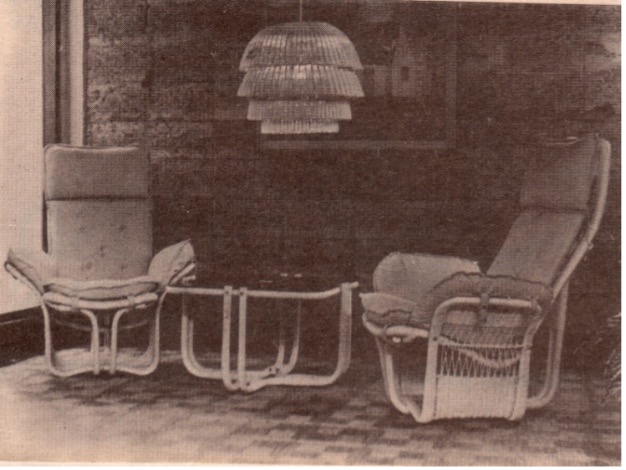
The intention of the project was “to not only improve the quality of workmanship but… how to teach them to know how to read a drawing from a draftsman (and) how to design product for interior living rather than exterior product… and thirdly how to rationalise production method rather than from A to Z done by one person. And, (finally) introduce the finishing.” Essentially, the design work was about creating consumers by changing how people perceived the value of rattan from a cheap, throw-away material, to a desirable piece of furniture. And now, “Cirebon grows … a very, very gigantic centre of rattan furniture in Indonesia. And containers and containers sent abroad. And then later on … a lot of foreign investors built their factories over there…”
During this and other projects seeking to enhance existing cottage industries, Pak Buchori did implement some of Papanek’s ‘Design for the Real World’ teaching. “When I translate the ‘real world’ to the village craftsmen of rattan, I also learn from them and I taught them a new approach of design and the rest they have to do themselves. And that was also practiced in other fields. Like shoe industry in Cibaduyut – we give also instructions, but they already (have) the skill, so we don’t need to give them skills anymore. … And also with bamboo… (the) people from Tasikmalaya are very crafty, their craftsmanship is very high, but there are many things they don’t know, like what is a design, they make something like – I don’t know whether you are familiar with it – Petromax? … They make out of bamboo you see, it’s a very crafty one (!), but I think it’s very silly (!). Why (they) have to copy that? But why can’t you make … something very modern one, approach, and good finishing, and that was done by a friend of mine. The work was very, very creative one. Make a basketry, and then export it … That is the way we educate them…”
This consumer oriented approach to ‘real-world’ design by his student may have surprised Papanek who was not in the business of creating consumers, however this was the ‘real-world’ experienced in 1970s Indonesia, where some of Papanek’s ideas didn’t always make sense. The famous cow-dung radio developed by Papanek in 1962 intended for manufacture for and by rural communities was one such example. “(Papanek) talk(ed) about designing a radio with some sort of used materials and with lace, you know, people can make it the product of radio, it is something like that, which I found it just silly, sorry to say that, it’s silly, the product is not very good at all! As it perhaps, PERHAPS, to exaggerate the concept. But frankly speaking I really love the philosophy of Papanek, but when it comes to the design that’s given to Balinese people, the Balinese people was very creative and intelligent you know, they know much more than that.” In fact, the radio had not been designed for Indonesia at all but for rural India at the request of the US Army who proposed that a low-cost radio for rural areas would be useful to improve education and public information broadcasting – a general trend at the time. However, when Papanek finally presented his idea, the US Army had turned off the idea, concerned that the radio would allow broadcasts by pro-communist groups. Only later did UNESCO pick up the idea and attempt to implement the design in Bali.
Pak Buchori spent his life working in Indonesia and was familiar with the design challenges faced by the country which went beyond individual products. His concern from the beginning was to build a national industrial design infrastructure. “The whole of my life I stay in the University, I don’t know, Papanek I think moved from one place to the other place, not stationed in one university. I remember that he was also assigned in Holland, assigned in Japan, moved all the time you see. But here at ITB I have obsessions to … face with the conditions …(of) being the most advanced technological university in Indonesia.” On the one hand Pak Buchori was concerned with working to support the development of an industrial design profession, while also developing a meaningful industrial sector which could absorb them when they completed their training. “by that time, Indonesia talking about industrialisation, is nothing…, because industrial product mostly imported. By that time, you see. We have industry but you know, what they make is just copy paste from the West, or otherwise to buy mould from outside and inject it here and then produce like ‘product of Indonesia’, which actually there was no involvement of design at all. So, we find difficulty, how to survive this design profession if there was no industry by that time. Our industry (is) based on craft, craft is already high, but that is not the idea of industrial design. Craft design is craft design. So, the way I give the education I… make the students smart, to make students, (which) can survive in any obstacles.”
“Industrial design is very wide, you see, related to industry, related to politics, related to many things.” “the philosophy of design thinking in my opinion is that … I give as much knowledge as possible to the students and they can extrapolate for themselves to be able to survive.” In this way graduates from ITB went on to study and work overseas, work in high tech industries including the military and banking, develop interdisciplinary design consultancies, and begin to develop a foundation for design research. “a lot of our graduates from here can survive, they can survive doing anything!”
Papanek and Pak Buchori maintained contact in relation to ‘real-world design’. “Victor Papanek went to Indonesia and I ask him to come to ITB to talk … (and) he asked me to join, (what) by that time was called Design for Developing Countries – some information group, it was a branch of organisation … called ICSID… one of the founders was Victor Papanek and (a) designer from India, I don’t remember his name, but those people (were) interested in the philosophy of the real-world design by Papanek, and since I’m from a developing country, … (I was) also involved in that one.” However, rather than experiencing Papanek’sunderstanding that the world had too many consumers, Pak Imam Buchori saw a world with too few for an industrial design community – let alone a responsible one – to flourish in Indonesia. “Well I think that the new generations are consumers… But no, consumer as a whole that’s still not – just my opinion – are not too critical of buying things you know.”
Now 78, Pak Buchori still considers the question of where industrial design can and should be positioned in Indonesia. “I’m conflicted by the term design in Indonesia and the term of design that I believe… When we talk, in Indonesia …about design, it’s always design in higher education, always related to engineering you see. Whereas, to my concern… design belongs to the side of culture outside the material world as practiced by engineering designers… and its actually emerged from the culture and social interaction … And then comes about the imagination that’s appropriate – what is meaningful for … running our world. So, … design in this case is related to configurations of form, making of form which is appropriate for the next step we face, because of the phase of technological process and scientific progress. So, that’s in my opinion… (the) cultural aspect is neglected…Perhaps the way we perceive the world is changing you see but we have to remain (social), and not merely belong to (technology).”
- Correspondence with William Lund (1972), https://designschoolarchive.calarts.edu/tagged/victor-papanek Accessed 01/01/2018
An alternative telling of the above interview can be found in Victor Papanek: The Politics of Design, Edited by Alison Clarke.
 vicky gerrard